Entry
Do not mix a return-to-court choice with the Li Tai departure branch in one experimental save.
Li Tai route and branch-save guide
This Road to Empress 2 Li Tai route guide brings the entry branch, Prince of Wei boundaries, community evidence, save slots, and spoiler-aware ending checks into one practical page.

Quick answer
Do not mix a return-to-court choice with the Li Tai departure branch in one experimental save.
Use Steam for product facts and community route notes for tested clues; they are different evidence types.
Confirm the route result first, then collect endings and Feats from a preserved branch save.
Search-intent boundary
| Player question | This page answers | Next page |
|---|---|---|
| How do I enter the Li Tai route? | The opening branch and a safe entry save | This page |
| What should I record? | Scene, witness, state, and result notes | This page and choices guide |
| What is the Prince of Wei side story? | Where the main route and side-story boundary sits | Side story guide |
| Where is every exact line? | Why a full line-by-line table belongs elsewhere | All choices guide |
| What are Li Tai's endings? | A spoiler-aware order for checking the outcome | Endings guide |
| How do I finish 100%? | When to review Feats after route confirmation | Achievements guide |
The phrase Road to Empress 2 Li Tai route usually signals a route task, not a request for a character biography. Players want to know which early choice points toward Prince of Wei, where the main story should be separated from a side story, and how to compare a community choice list with the screen in their own language. This page explains that repeatable work order.
Public walkthroughs use different numbering systems and translations. One guide may use a continuous chapter number, while another names a Story Map node or a side chapter. Rather than pretending one line is universal, this guide identifies the confirmed direction and gives you a save-and-record method. Use the choices guide when you need exact dialogue wording.
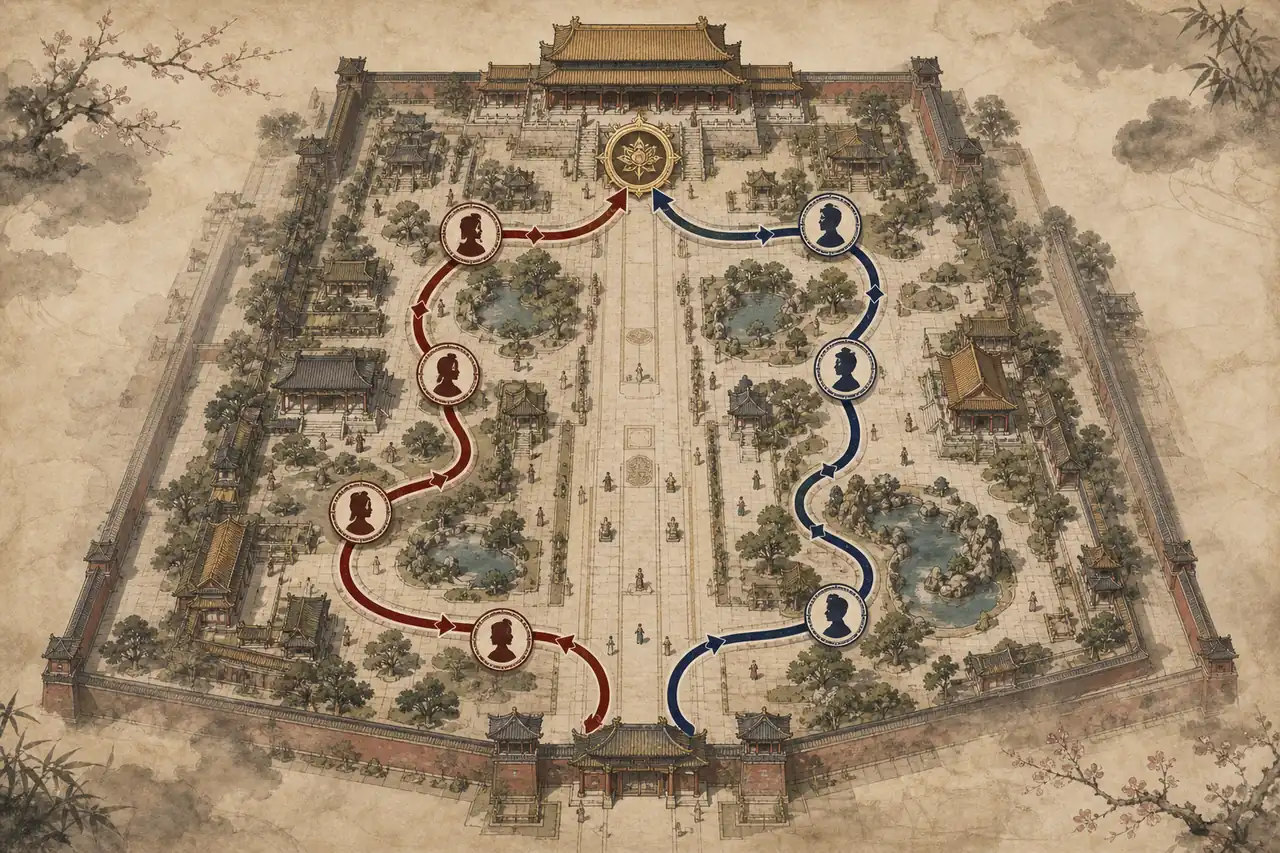
The currently readable main-story notes describe a broad prologue split. A choice close to leaving this place to begin a new life is associated with the Li Tai and New World direction, while returning to the court to challenge power is associated with the Li Zhi and Empress direction. Localized wording may differ, so verify the Story Map route and location immediately after choosing.
Record the next scene as well as the selected line. A translated sentence can be ambiguous, but the newly opened node, location, and objective give you a stable comparison with an English guide or a community record.
Keep a stable main-story save before the Li Tai entry choice.
Write the scene, place, people present, and public or private state.
Change one choice at a time and compare the next node or result.
When a guide differs, check language, patch, and earlier relationship state.
After the route result, review endings and Feats from a separate cleanup save.
Li Tai searches often mention Prince of Wei, the Ganye Temple escape, and New World together. The side-story guide treats that block as a separate route instead of simply continuing the main-story chapter number. It is still the same game, but its escape objective and item choices should not be judged by the court-survival rules of the main campaign.
If your result differs, compare the side-story node, language, patch, and previous relationship state before calling the route broken. Keep the side-story result separate from the main Li Tai result until the ending screen confirms how they connect.
A practical layout uses three slots. The first is the last stable main-story save. The second is the Li Tai entry or side-story entrance save. The third is disposable and tests one variable. Long FMV scenes make replays expensive, so creating the second slot at the first warning sign usually saves time rather than adding work.
Never use the stable slot for an unverified experiment. If a guide recommends a different item or relationship action, load the entry save, change only that factor, and keep the result beside the original note.
Copying a single correct answer is fragile when another player's screen differs. Record the scene, location, conversation partner, public or private setting, evidence held, relationship state, immediate result, and next node. That short record lets you compare meaning even when localization changes the visible sentence.
When two answers look plausible, keep the branch save, choose one, and compare the next confirmed state. Do not label a line as universal until the same state reproduces the same result in your own language and patch.
Steam Community and independent guides can reveal choice order that an official product page does not document. They are player tests made with a particular save, language, and update. If a note says one choice guarantees a Li Tai ending, first verify that your chapter, node, relationship, and evidence state match; otherwise treat it as a hypothesis.
A preserved entry save lets you test one condition without replaying every long scene. Keep a spoiler-light note for entry and a separate high-spoiler checklist for endings, Feats, and achievements.
Sources and evidence level
FAQ
Continue reading